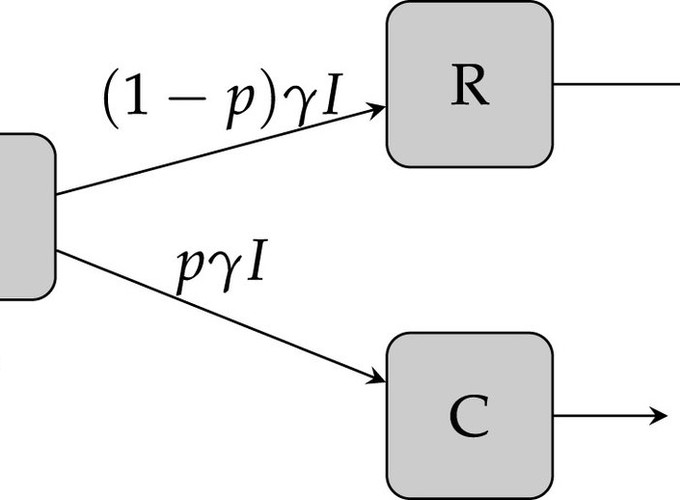
Abstract In this paper, an epidemiological model of hepatitis C with acute and chronic infections is proposed, and then the global dynamics of this model is studied. It emphasizes that acute hepatitis C patients can eliminate the virus by themselves and step into the recovered class, while chronic hepatitis C patients can-not automatically eliminate the virus to enter into the recovered class, so a significant number of those patients eventually develop cirrhosis or hepatocellular carcinoma (HCC). By constructing appropriate Lyapunov functions, it shows that if the basic reproductive number R 0 1 , the disease-free equilibrium of the model is globally asymptotically stable; if R 0 > 1 , the disease-free equilibrium is unstable, and the endemic equilibrium of the model is globally asymptotically stable.