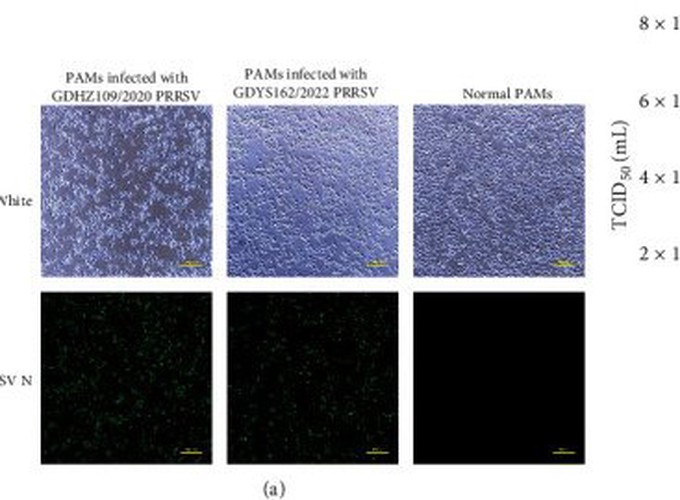
NADC34-like porcine reproductive and respiratory virus (PRRSV) has had a significant impact on the pig industry, particularly in China. However, the evolutionary characteristics and pathogenicity of NADC34-like PRRSV strains within intensive farming systems are not well understood, particularly regarding the biological characteristic variation of successive outbreaks on a farm. In this study, we conducted continuous surveillance in an intensive farm that experienced a PRRSV outbreak. Two PRRSV strains, GDHZ109/2020 and GDYS162/2022, were isolated and fully sequenced from the same swine farm in Guangdong Province in 2020 and 2022, respectively. Evolutionary analysis based on the ORF5 gene revealed that both strains clustered with NADC34-like strains and shared 96.5% homology. Analysis of the full-length genome and NSP2 gene classified the strains into lineage 1.8, represented by the NADC30 strain. Recombination analysis suggested complex recombination patterns for both strains, involving NADC30-like, NADC34-like, and JXA1-like strains. Although many recombinant regions were nearly identical, there were differences observed in the NSP5-NSP7 region. Pathogenicity experiments conducted on piglets demonstrated that GDHZ109/2020 exhibited higher pathogenicity compared to GDYS162/2022. Piglets in the GDHZ109/2020 infected group had more severe clinical signs and higher mortality. Moreover, analysis of respiratory microbial diversity indicated a significant increase in the abundance of potentially pathogenic microbiota, such as